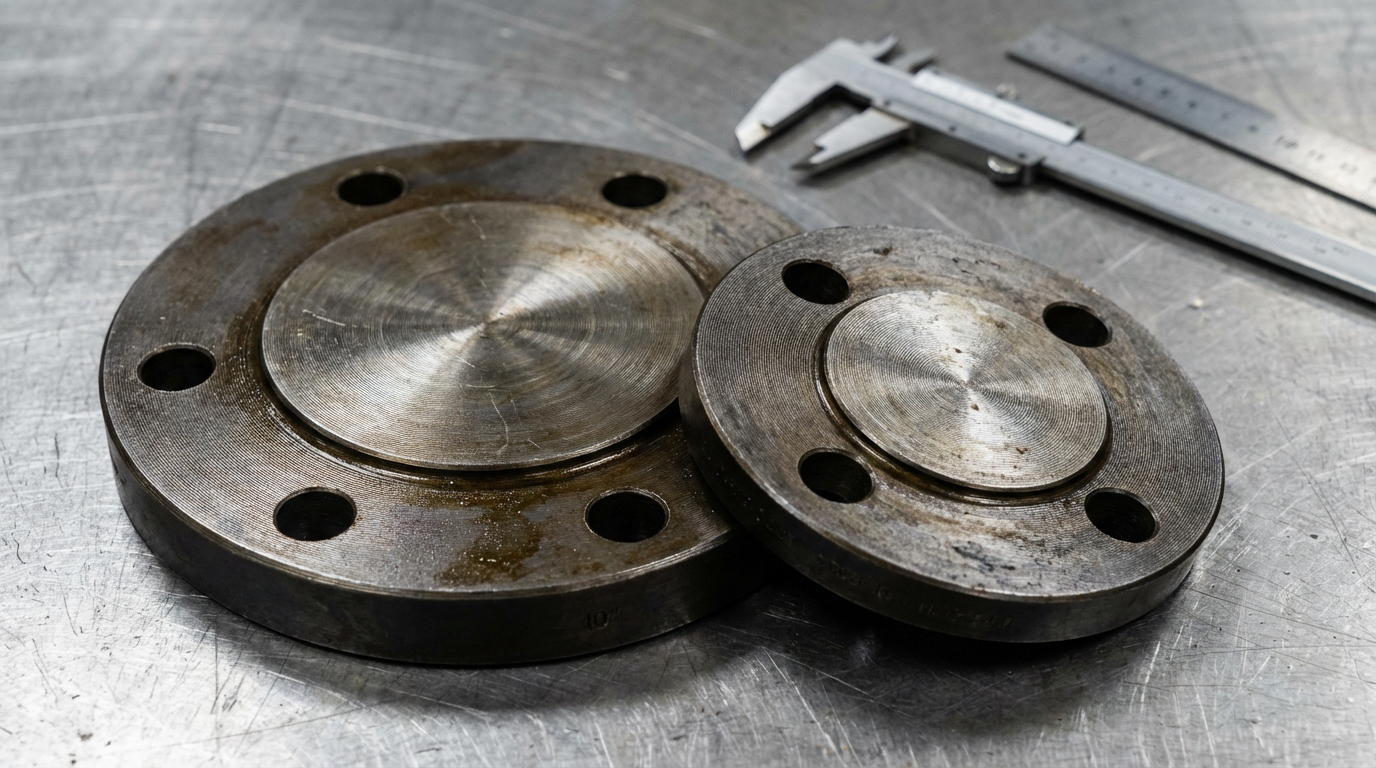
A blind carbon steel pipe flange is a simple but essential component. It is a solid, disc-shaped plate with no center hole (bore). Its job is to seal the end of a pipe, pressure vessel, or valve, effectively creating a stop.
This guide explains what blind flanges are, why carbon steel is a common material for them, and where you should use them.
What is a Blind Flange?
A blind flange looks like a standard pipe flange but without an opening for flow. It has bolt holes around its perimeter to match a mating flange. When installed with a gasket and properly bolted, it creates a pressure-tight closure.
Its primary functions are to:
- Isolate or seal off a section of piping.
- Provide access for future expansion or cleaning.
- Allow for pressure testing of systems.
- Close off unused connections on vessels or manifolds.
Why Use Carbon Steel (ASTM A105)?
Carbon steel, specifically ASTM A105, is the most common material for forged flanges in industrial service. It offers a practical balance of properties.
- Strength & Durability: It has excellent mechanical strength to withstand high pressure and mechanical loads.
- Cost-Effectiveness: It is more affordable than stainless steel or alloy steels for many applications.
- Temperature Range: Suitable for a wide range, from ambient temperatures up to approximately 537°C (1000°F). For low-temperature service, a different specification like ASTM A350 LF2 is used.
- Machinability & Weldability: It is relatively easy to machine and weld, making fabrication and installation straightforward.
Forged vs. Cast: Manufacturing Matters
Most high-performance carbon steel flanges are forged, not cast.
- Forged Flanges (like ASTM A105): Made by shaping heated steel under high pressure. This process refines the grain structure, creating a stronger, more reliable, and uniform product with better mechanical properties. It is the preferred method for pressure-containing components.
- Cast Flanges: Poured as molten metal into a mold. They can have hidden defects like porosity and are generally weaker. They are less common for critical pressure services.
For more on material grades, see our comparison of Carbon Steel A105 vs A106 Flanges.
Key Features of Blind Carbon Steel Flanges
- Solid Web: The defining feature is the solid center, which provides the sealing surface and pressure containment.
- Standard Dimensions: They conform to ASME B16.5 (up to 24 inches) or ASME B16.47 (larger diameters). This ensures they bolt up correctly to mating flanges of the same pressure class and size.
- Pressure Classes: Available in standard ANSI/ASME pressure classes: 150, 300, 400, 600, 900, 1500, and 2500. The class indicates the pressure-temperature rating.
- Face Types: The sealing face can be:
- Raised Face (RF): Most common. A small raised ring provides a higher stress area for the gasket.
- Flat Face (FF): Used when mating with another flat face flange, often on cast iron equipment.
- Ring-Type Joint (RTJ): Has a groove for a metal ring gasket, used for very high-pressure service.
- Finish: Faces are typically serrated (e.g., 125-250 microinch finish) to provide grip for the gasket and improve the seal.
Common Applications in Industry
Blind flanges are used wherever you need to permanently or temporarily stop flow.
- Pressure Testing: Installed at the end of a pipeline section to “blind off” the line during hydrostatic or pneumatic tests.
- System Isolation: To isolate a section of piping for maintenance or repair without draining the entire system.
- Future Connections: Placed on branch connections or vessel nozzles that are not currently in use but may be needed later.
- Pipeline Termination: Used at the end of a pipe run or at a dead-leg.
- Manway Covers: On smaller pressure vessels or tanks, a blind flange can serve as a removable cover.
- Safety: To prevent accidental ingress of foreign material into an open pipe end.
Technical Specifications and Selection
Pressure-Temperature Ratings
A common misunderstanding is that “Class 150” means 150 PSI at all temperatures. The rating is temperature-dependent. A Class 150 carbon steel flange is rated for ~285 PSI at ambient temperature, but its maximum allowable pressure decreases as temperature increases.
| Temperature (°F) | Class 150 (PSI) | Class 300 (PSI) |
|---|---|---|
| 100 | 285 | 740 |
| 200 | 260 | 675 |
| 400 | 200 | 555 |
| 600 | 140 | 410 |
How to Specify a Blind Flange
To order the correct flange, you need:
- Material: ASTM A105 (Forged Carbon Steel).
- Size: Nominal Pipe Size (NPS) of the pipe it will seal.
- Pressure Class: ANSI Class (e.g., 150, 300, 600) based on your system’s maximum operating pressure and temperature.
- Facing: Raised Face (RF), Flat Face (FF), or Ring Type Joint (RTJ).
- Dimensions: Standard per ASME B16.5 or B16.47. Special thicknesses can be ordered if required by design.
Note: For high-quality industrial flanges used in piping and fabrication, visit Texas Flange, a trusted flange manufacturer specializing in precision-engineered flange solutions.
Comparison with Other Flange Types
| Feature | Blind Flange | Weld Neck Flange | Slip-On Flange |
|---|---|---|---|
| Purpose | Seal an end. | Connect pipe with a strong, welded joint. | Connect pipe easily, with fillet welds. |
| Internal Bore | None (solid). | Matches pipe ID for smooth flow. | Slightly larger than pipe OD. |
| Best For | Isolation, testing, termination. | High-stress, high-pressure permanent lines. | Low-pressure, non-critical applications. |
| Cost | Moderate. | Higher (more material, welding). | Lower (less material, easier install). |
Installation and Handling
- Gasket Selection: Use a full-face gasket for Flat Face (FF) flanges or a ring gasket for Raised Face (RF) flanges. The gasket material must be compatible with the service fluid and temperature.
- Bolting: Use the correct number, size, and material of bolts/nuts. Follow a cross-bolt tightening pattern (e.g., star pattern) to compress the gasket evenly. Uneven bolting can cause leaks or warp the flange.
- Lifting: Large, heavy blind flanges require proper lifting gear. Use lifting lugs if provided, or slings around the flange body—never use the bolt holes for lifting.
- Corrosion Protection: While carbon steel is strong, it can rust. For corrosive environments or outdoor storage, consider protective coatings like paint, varnish, or galvanizing.
Advantages and Disadvantages
Advantages:
- Provides a secure, positive seal.
- Reliable for pressure testing and isolation.
- Available in all standard sizes and pressure classes.
- Durable and long-lasting when material is correctly specified.
- Simple design with no moving parts.
Disadvantages:
- Heavy, especially in larger sizes and higher classes.
- Adds weight and cost to a system.
- Requires full bolting and unbolting for access, unlike a spectacle blind or spacer ring.
Frequently Asked Questions (FAQs)
1. How is a blind flange different from a pipe cap?
A pipe cap screws or welds onto the end of a pipe itself. A blind flange bolts to another flange, creating a flanged connection that is easier to open for future access.
2. Can a blind flange handle the same pressure as a weld neck flange of the same class?
Yes. The pressure rating is based on the material, dimensions, and class, not the flange type. A Class 300 blind flange has the same pressure-temperature rating as a Class 300 weld neck flange of the same size and material.
3. What is the difference between a blind flange and a spectacle blind?
A blind flange is always solid. A spectacle blind (or “line blind”) is a single assembly with a solid section (like a blind) and an open section (like a spacer). It can be rotated in or out of the line to isolate flow without unbolting the connection, used for frequent isolation.
4. How thick is a blind flange?
The minimum thickness is defined by the ASME B16.5 standard for each NPS and pressure class. It is often thicker than a weld neck flange of the same rating due to its solid design. The thickness can be calculated for specific non-standard conditions.
5. Are carbon steel blind flanges suitable for steam service?
Yes, ASTM A105 blind flanges are commonly used for steam service within their temperature rating limits (up to ~537°C / 1000°F). Always check the pressure-temperature rating table for the exact allowable pressure at your steam temperature.
6. Can I weld a nozzle to a blind flange?
Yes. This is a common practice to create a custom flanged connection. A hole is drilled in the center of the blind flange, and a pipe nozzle is welded into it. The assembly must then be re-rated as a custom component unless performed per a recognized code.
7. How do I prevent a blind flange from corroding?
Apply a suitable protective coating like high-temperature paint or industrial enamel. For very corrosive environments, you may need to select a different base material, such as stainless steel (ASTM A182) or a coated carbon steel.
Conclusion
Blind carbon steel flanges are straightforward, vital components for managing and isolating piping systems. Their strength, reliability, and standardization make them the default choice for sealing pipe ends in thousands of industrial applications.
When you need to block a line for testing, maintenance, or future use, an ASTM A105 blind flange is typically the correct, cost-effective solution. Always specify the correct pressure class and facing for your service conditions, and follow proper installation procedures to ensure a leak-free, safe seal.